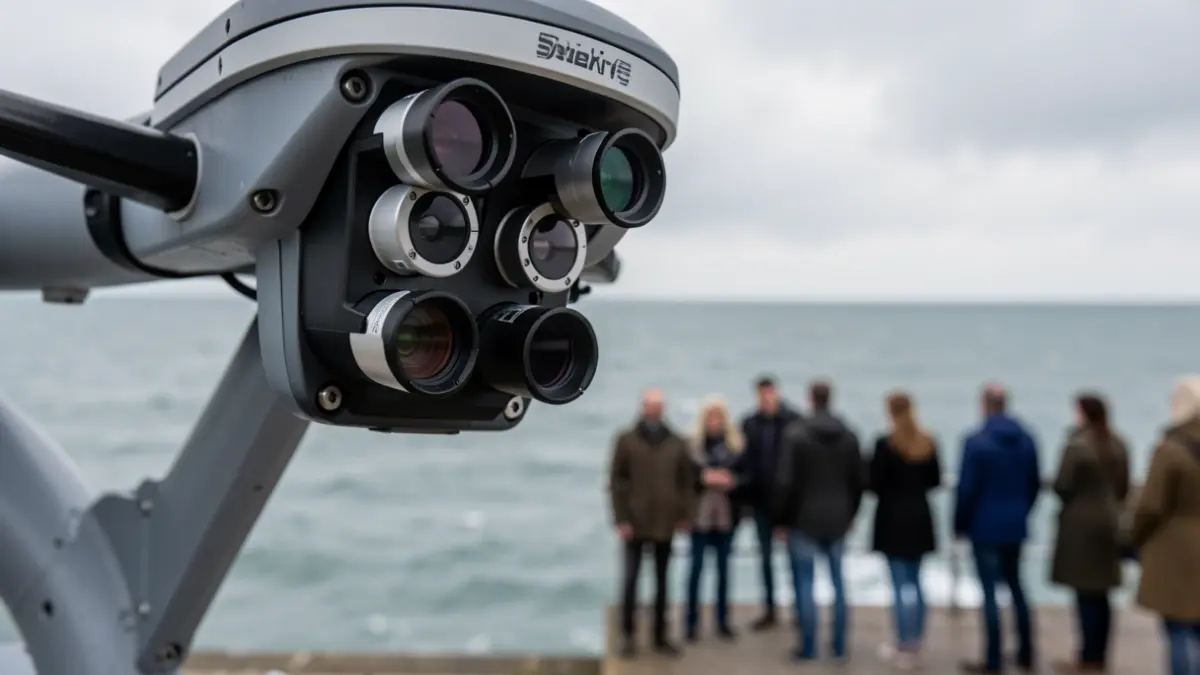
The third edition of the Multipurpose Maritime Operation (MMO) off our coast has concluded. Throughout the summer, Belgian, French, Dutch, and European partners collaborated on maritime exercises and operations in the Channel and the southern North Sea. This was made possible by the European agencies EMSA, EFCA, and Frontex. For the Maritime Services and Coastal Division (MDK), this provided an opportunity to test new resources, refine procedures, and strengthen cooperation with coast guard partners.
Sofie Rommelaere, an MDK colleague and coordinator of the MMO on the Flemish side, highlighted the increased participation of Flemish and federal partners such as the Agency for Agriculture and Fisheries, the Royal Belgian Institute of Natural Sciences, Defence, DG Environment, DG Shipping, and the Maritime Police. "Partners have seen that tangible results can be achieved with the MMO. You can test innovations extensively, free of charge. In times when everyone has to save, this is particularly interesting," Rommelaere stated.
The Netherlands participated for the first time this year, which was particularly interesting for testing drones over the North Sea, as part of the Flemish operational area falls under Dutch airspace. The Netherlands, in turn, was interested in testing the underwater drone (ROV) for securing subsea cables and critical equipment. The ROV inspected, among other things, a shipwreck and an oyster restoration zone, collecting high-quality images thanks to favorable weather conditions.
The flying drone (RPAS) took off from the Belgian coast for the first time this year, operating from the military base in Lombardsijde, which was more efficient than launching from France last year. The drone was used for monitoring tasks and preventively by MDK and the Maritime Police to detect potential migrant departure attempts from the Belgian coast. There is hope to deploy the drone in future real incidents, for example, to quickly transmit situational images to responding rescue units or to drop lifebuoys.
During the Search and Rescue exercise (SAREX), led by the MRCC Ostend, plans had to be adapted when two helicopters unexpectedly dropped out. The focus shifted to medical pre-triage aboard the Sirius, a vessel from Vloot (Fleet). The crew of Vloot had to assess the medical condition of the 'victims', categorizing them by injury severity to determine who needed urgent help. Observers from the Red Cross deemed this triage highly professional. Transferring stretchers from smaller to larger vessels was also practiced, demonstrating the strength of flexible response to changing circumstances during a real incident.
During POLEX, an annual oil spill response exercise, Belgian and Dutch ships collaborated on a scenario involving an oil slick moving towards both countries. Despite challenging wave heights, the main objectives were largely achieved.
According to Sofie Rommelaere, the greatest benefit of the MMO lies not only in individual tests and exercises but also in the improved mutual understanding and cooperation between organizations and countries. "Beyond the concrete results, you build a better relationship with your neighboring countries and the European agencies EMSA, EFCA, and Frontex. But also within Belgium, you get to know partners better. You quickly know who to contact for what. These personal and operational networks are extremely valuable when something truly happens."
While a fourth MMO has not yet been decided, MDK is a candidate to participate again. Discussions are underway regarding other activities and resources, such as different types of drones. France advocates for a permanent character of the MMO, and Flanders is exploring the idea of an international pool of ships and drones. This could evolve the three years of experimentation within the MMO into a sustainable form of European cooperation at sea.