The Antwerp city council today approved the ‘Ontwikkelingsvisie R1 Zuid’ (R1 Zuid Development Vision). This vision outlines a potential future development scenario for a safer and more compact southern Ring, including nearly 4 kilometers of capping. The vision was developed by the team of intendant Alexander D'Hooghe, in collaboration with the partners of the Toekomstverbond (Future Alliance). For the city of Antwerp, this vision serves as a framework for future investments and can be integrated into the expansion of the Strategic Spatial Plan Antwerp. The city also aims to maximize the insights from this study for the next sub-projects within the Ringpark Groene Vesten (Green Vesten Ring Park).
The Toekomstverbond, established in 2017 between the Flemish government, city of Antwerp, Port of Antwerp, and citizen movements stRaten-generaal, Ademloos, and Ringland, aims to complete the Antwerp Ring with the Oosterweel connection and route cars underground through capping. This initiative seeks to improve mobility, increase green spaces, and ensure cleaner air in Antwerp.
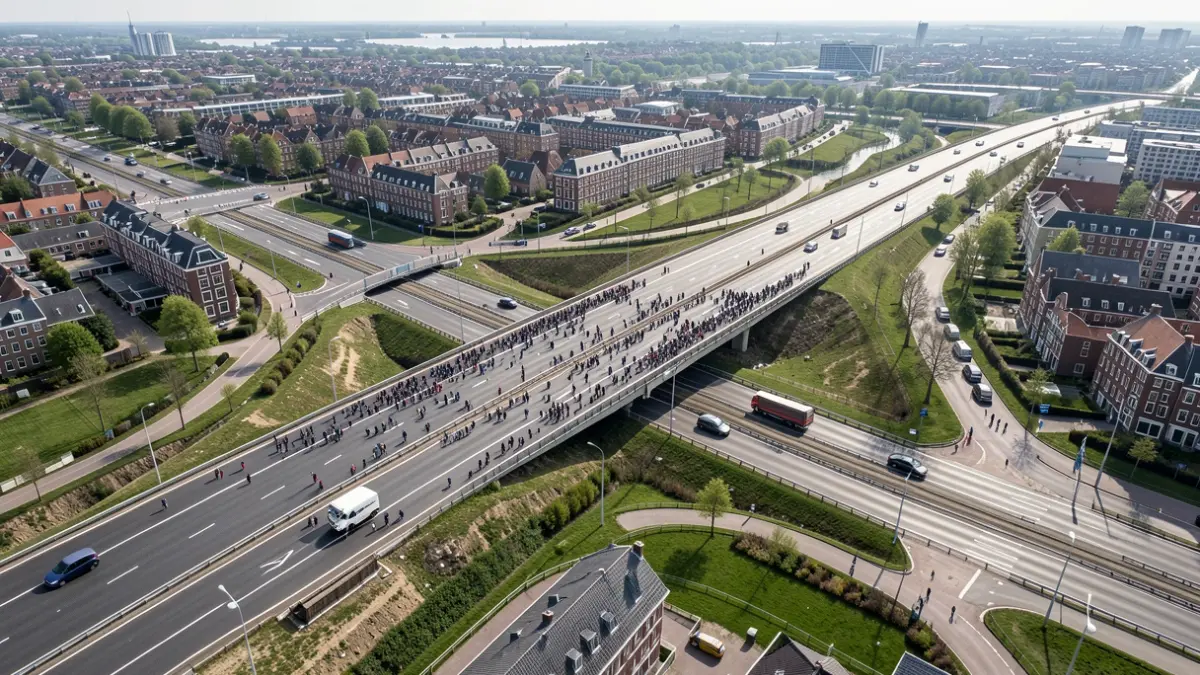
With the Oosterweel connection under construction and the capping of the northern Ring in the permit and execution phase, the approval of this development vision marks a new milestone for the southern Ring (R1 Zuid). A development vision is a future-oriented study describing how an area might develop. This vision illustrates how R1 Zuid could be designed to be safer, smoother, and more compact, freeing up space for nearly 4 kilometers of additional capping, three new Ring Parks, and connections between neighborhoods.
Alexander D'Hooghe, intendant, emphasized its importance: “After Oosterweel and the northern Ring Parks, we are now also demonstrating for the southern Ring that a smoother, more compact, and safer traffic system for Flanders and improved liveability for Antwerp go hand in hand. Several large and promising capping projects are planned. The next step is to develop a future roadmap.”
The R1 Zuid is a crucial traffic artery for Flanders, essential for the transport of goods, services, and people, and connecting the port to the rest of Europe. Antwerp's accessibility directly impacts Flanders' economic prosperity. The Ring, once on the city's outskirts, now runs through residential areas, schools, and sports fields. The vision starts from a simplified traffic system, enabled by the Oosterweel connection, leading to fewer complex weaving movements and safer traffic flow.
Koen Kennis, Antwerp's alderman for mobility, added: “When we signed the Toekomstverbond in 2017, we expressed the ambition to close, soften, and fully cap the Ring. With this development vision, there is now a technically substantiated future outlook for R1 Zuid. Oosterweel will change traffic flows on the Ring and create new opportunities to organize this section more safely and smoothly, with space for capping, Ring Parks, and new connections between neighborhoods. Mobility and liveability coming together here is precisely what we have been working on with De Grote Verbinding (The Great Connection) for years.”
A simpler design of the Ring could free up space for new capping projects and pedestrian/cycling bridges connecting neighborhoods currently separated by the Ring. Three new Ring Parks could be created: Ringpark De Knoop (around the E313 junction), Ringpark Groot Brialmont, and Ringpark Mastvest. These parks could accommodate green spaces, water buffering, sports facilities, meeting areas, and opportunities for new housing and amenities.
Manu Claeys of stRaten-generaal highlighted the successful co-creation: “It proves once again that co-creation leads to the best results. By continuing to build a supported plan together, we now have a technically substantiated proposal that all partners endorse and can further refine and optimize.” Peter Vermeulen of Ringland added their satisfaction with the commitment to work towards a maximally capped Ring, which will enhance quality of life, public health, and climate adaptation.
The R1 Zuid Development Vision is a clear goal for the future, providing Flanders and the city of Antwerp with a compass for major investments along the R1 Zuid in the coming decades, ensuring they are planned cohesively with a long-term perspective that strengthens both mobility and liveability.
The city of Antwerp is establishing principles as a framework for future investments in the southern Ring zone and incorporating the vision into the ongoing expansion of the Strategic Spatial Plan Antwerp (SRA). The city will also continue to collaborate if Flanders initiates further studies. Additionally, the council is committed to advancing the planned sub-projects within Ringpark Groene Vesten, taking the insights from the development vision into maximum account.
On Saturday, October 24, 2026, the city of Antwerp, Flanders, Lantis, and the citizen movements will host another Ringdag (Ring Day) at the Crowne Plaza hotel from 10 AM to 5 PM. This eighth edition will focus on the potential future of the southern Ring, providing updates on the seven Ring Parks and the Scheldebrug, and offering spectacular views of the southern Ring zone from the hotel's 16th floor. Attendees can also participate in information sessions or visit the Pomppark Zuid construction site. The full program is available at degroteverbinding.be/ringdag.