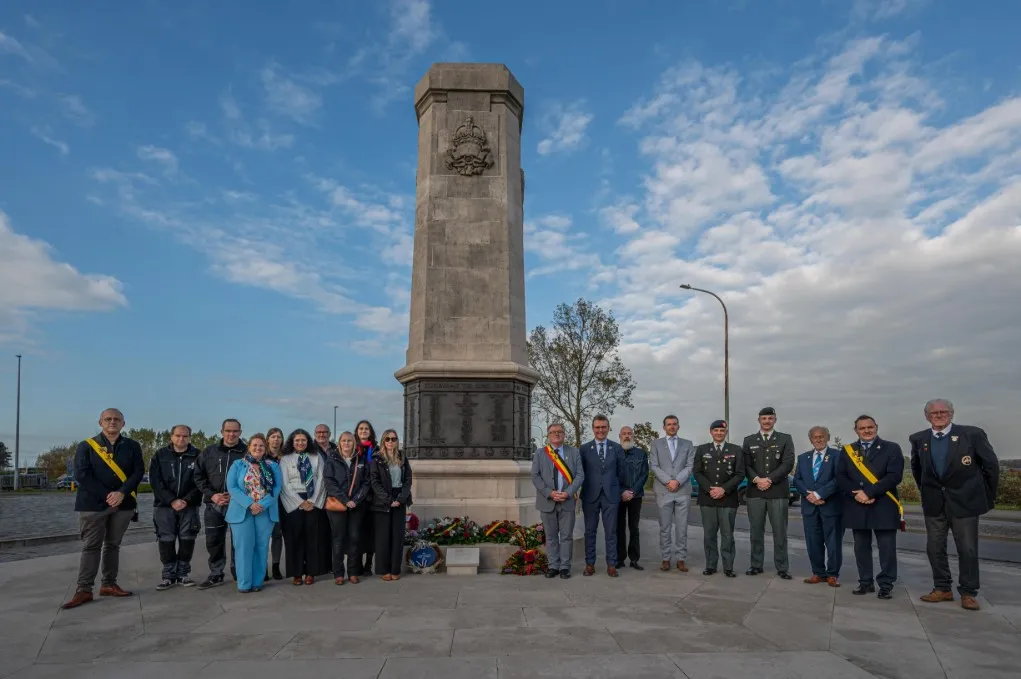
The city of Nieuwpoort and the Commonwealth War Graves Commission (CWGC) unveiled a Unesco memorial stone at the Nieuport Memorial on Thursday, October 29, 2026. The stone underscores the international heritage value of this British memorial monument for the remembrance of World War I.
The ceremony was attended by the city council, representatives from the CWGC and Unesco, and over 100 pupils from Nieuwpoort's three primary schools. In 2023, 139 cemeteries, memorials, and monuments related to World War I in Flanders, Wallonia, and France were granted Unesco World Heritage status. No fewer than 27 of these commemorative sites are located in the Westhoek, including the Nieuport Memorial at the Sluices in Nieuwpoort. The CWGC is placing Unesco memorial stones at the recognized commemorative sites in the Westhoek in 2026 to make the international recognition visible on location.
The Unesco recognition is part of a cross-border initiative concerning the cemeteries and commemorative sites of World War I along the former Western Front. The Belgian and French authorities jointly submitted the candidacy, which encompasses a total of 139 locations. The recognition confirms the exceptional universal value of these places, where people of different nationalities and beliefs are commemorated, and acknowledges the work of the CWGC, which has been responsible for the management and maintenance of British and Commonwealth war cemeteries and memorials for over a century. These sites serve as reminders of the human cost of the conflict and carry a message of peace.
The Nieuport Memorial, officially inaugurated on July 1, 1928, is one of the first major commemorative monuments erected in Nieuwpoort after the Great War. It commemorates 552 British officers and men who fell during Allied operations on the Belgian coast but have no known grave. Their names are inscribed on bronze plates on the four sides of the central pylon. The monument, eight meters high, was designed by British architect William Bryce Binnie. The three recumbent lions at its base are the work of sculptor Charles Sergeant Jagger.
“
"At the Nieuport Memorial, more than 500 British soldiers who fell during World War I are commemorated. More than 500 people who lost their lives far from their homeland, far from their families and their familiar surroundings. With the unveiling of this Unesco memorial stone, we not only give recognition to the monument itself. We also express our respect to the people commemorated here. We make it clear that their names, their efforts, and their sacrifice must not disappear into the folds of history."
“
"Today we unveil this Unesco memorial stone and recognize the Nieuport Memorial as part of a larger landscape of remembrance of the former Western Front, recognized by Unesco as World Heritage. These stones remind us that remembrance is not a static fact. It is something we must actively continue to commit to, by being present, sharing knowledge and insight, and carefully maintaining these sites. We also renew our promise: the people commemorated here, and the millions of people they symbolize, will never be forgotten."
Nieuwpoort, a city with over 11,000 inhabitants, served as the starting point of the Western Front during World War I. The city boasts two Unesco World Heritage sites: besides the Nieuport Memorial, the belfry of the Stadshalle has also been recognized since 1999. The Commonwealth War Graves Commission (CWGC) is an international organization that has been responsible for commemorating military personnel and civilians who died during World War I and World War II since 1917.
Based on information from the official source: Stad Nieuwpoort (30/10/2026)