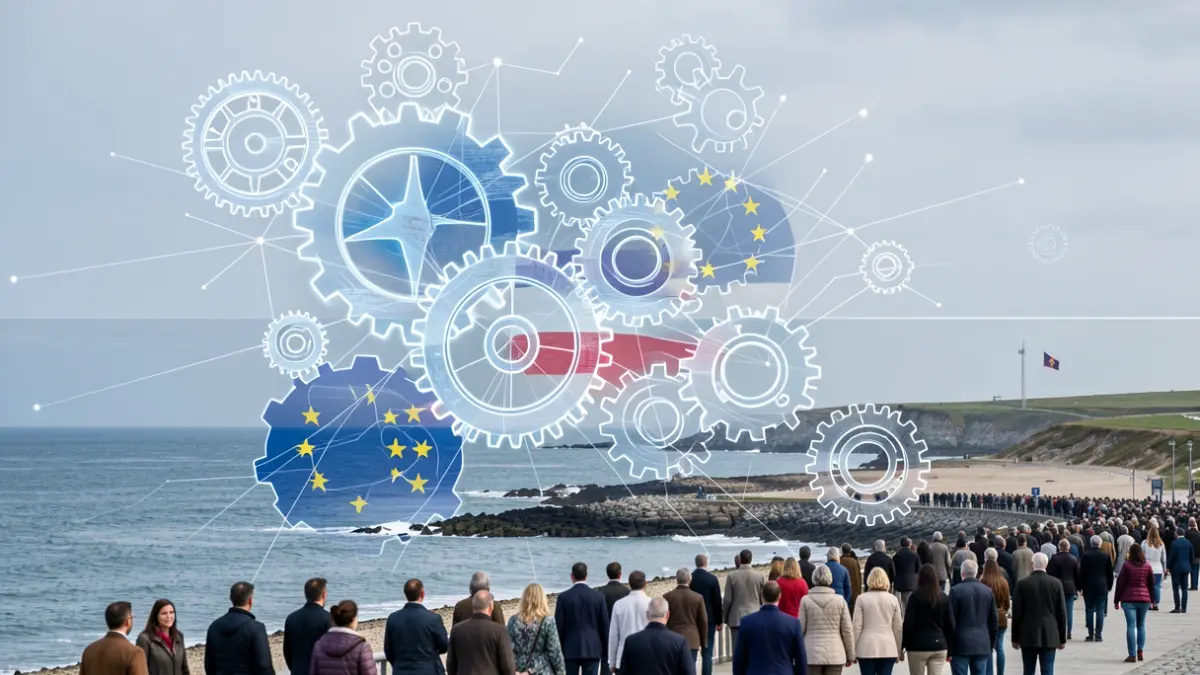
During the debate, organized by VLEVA and the Flemish Parliament, representatives from business, knowledge institutions, sector organizations, and policymakers discussed how to strengthen Europe's economic, technological, and geopolitical position. Topics included medicine security, semiconductor technology, energy supply, industrial capacity, and the future of the blue economy. A key theme was the need for stronger, more coherent European policies that make bold choices and invest in infrastructure supporting innovation and scaling up.
Ann Overmeire, COO of De Blauwe Cluster, presented the perspective of the blue economy, emphasizing the sea's crucial role for Europe's ports, energy production, food supply, and maritime transport. Flanders has established a strong position in offshore wind energy with a globally active value chain. Innovation in offshore solar energy, nature-based coastal protection, blue biotechnology, and aquaculture is also growing. Increasing pressure on the North Sea due to climate change and biodiversity loss necessitates an integrated approach.
De Blauwe Cluster highlighted the importance of the upcoming European Ocean Act for coordinated European ocean policy and advocated for strategic planning at the sea basin level, across national borders. This aims to better align energy, nature, security, and economic activities, and protect critical offshore infrastructure.
Regarding European industrial policy, De Blauwe Cluster stressed that Europe needs to do more to retain the economic value of offshore wind. Instruments like the Net-Zero Industry Act and the planned Industrial Acceleration Act should anchor investments in production capacity and innovation within Europe, thereby strengthening competitiveness and reducing dependency. Economic activities at sea can coexist with ecological ambitions by integrating nature from the design phase.
De Blauwe Cluster offered three recommendations to policymakers: 1) anchor strategic planning per sea basin in the future Ocean Act; 2) accelerate permitting processes and strengthen incentives for European production capacity in offshore wind; and 3) ensure coherent industrial, energy, and climate policies to mutually reinforce offshore wind, electrification, and industrial development.
The debate brought together Flemish stakeholders and policymakers to discuss the future of Europe, focusing on strategic autonomy, innovation, industry, energy, and sustainable economic development. De Blauwe Cluster emphasized the importance of the blue economy and the opportunities presented by the European Ocean Act and a stronger European industrial policy to achieve climate goals and enhance economic resilience.
Panelists included Caroline Ven (pharma.be) on medicine security, Luc Van den hove (imec) on technological innovation, Cas König (North Sea Port) on energy infrastructure, Frank Beckx (Voka) on industrial competitiveness, and Ann Overmeire (De Blauwe Cluster) on the blue economy. Their contributions formed the basis for discussions with Flemish and European policymakers.