The historic Pier Slot spring, located on Borrestraat in Sint-Joris-Weert, has been restored and is being repurposed as a public tap and water buffer. This project, part of the Local Drought Area Deal ‘(Re)springing in the Brabantse Wouden’, aims to make the spring water visible and usable again.
Historically, residents drew water from this spring, and later the railways used it to supply the steam tram ‘Zwette Jean’. After falling into disrepair, the spring, which could no longer be collected at its original location due to fluctuating groundwater levels, has been redeveloped. The restoration involved removing 25 meters of concrete slabs to allow for the natural development of spring-dependent vegetation.
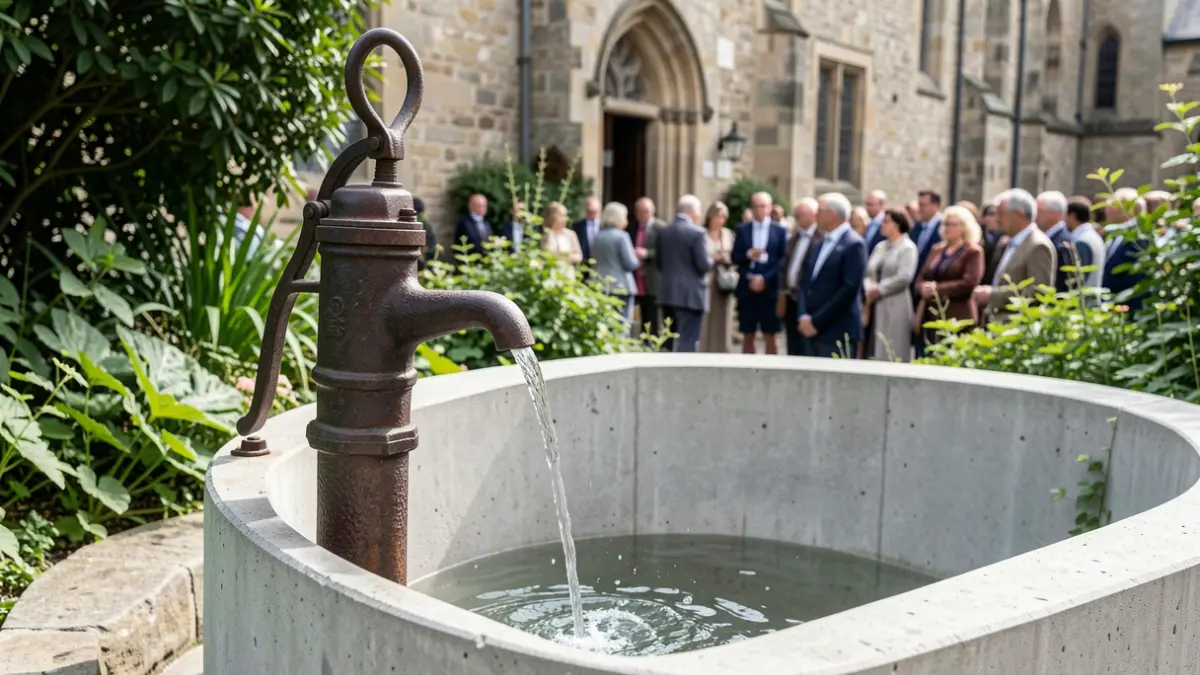
Downstream, the filtered spring water is collected and directed to a publicly accessible tap featuring a cast-iron hand pump. It then flows into a 10,000-liter capacity basin. While not potable, this water can be used for cooling, irrigation, and cleaning. A nearby plant center has direct access to the basin via a pump.
To address severe erosion and mud overflow in the hollow Borrestraat, a buffer berm has been constructed at the top. This temporarily retains rainwater, reduces peak flow rates, and promotes soil infiltration. Remaining water and silt are channeled separately past the spring zone, then directed into an existing ditch with five successive 'pinch' elements to slow down the flow, combining heritage restoration with water buffering, erosion control, and nature development.
The project, initiated by local associations and Regionaal Landschap Dijleland, received subsidies from the Flemish government's Department of Environment through the Local Drought Area Deals program and implements the Blue Deal. The province of Flemish Brabant and the Agency for Nature and Forest also contributed. The redevelopment is part of the strategic Walden project, a collaboration between the province, the Agency for Nature and Forest, the city of Leuven, and the municipalities of Bertem, Huldenberg, and Oud-Heverlee.