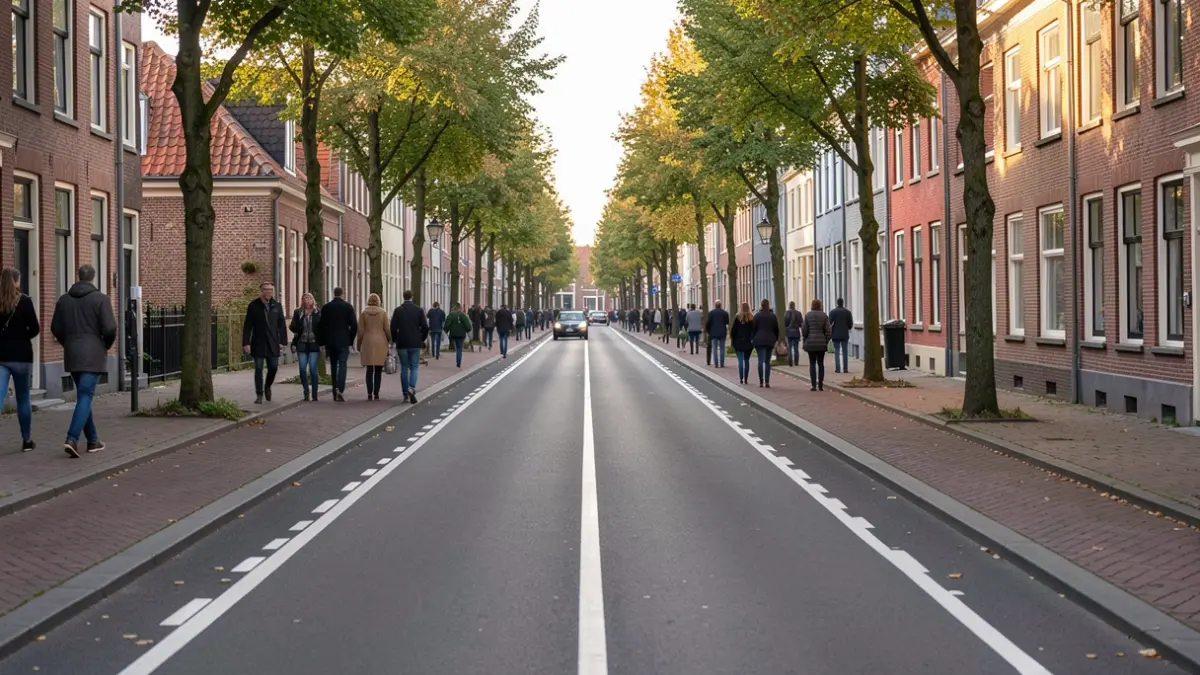
The safety of vulnerable road users is a priority for the local administration of Bertem. Consequently, Bosstraat, between the border with Veltem and the parking area of the Bertembos event halls, will be designated as a central lane. The new traffic situation will officially take effect once the road markings are completed, expected in early November.
A central lane consists of a single central roadway for motorized traffic, bordered by two side strips intended for cyclists, moped riders, and pedestrians. Cyclists are obliged to use these side strips. The width of the central lane is deliberately chosen so that two vehicles cannot pass each other there. If an oncoming vehicle approaches, car drivers may briefly move onto the side strips to pass, provided they do not endanger any cyclists or pedestrians present.
This concept differs from cycle-friendly lanes, although both road layouts may appear visually similar. There is a crucial difference in the rules: on a cycle-friendly lane, motorists can generally drive on it unless a cyclist is present, whereas with a central lane, motorists always drive in the middle lane and only move to the side lanes when an oncoming vehicle appears. Furthermore, the side strip of a central lane is not a cycle path and is not part of the main roadway. While cars are never allowed on a proper cycle path, they may use these side strips (to pass) on a central lane. To prevent potential confusion for drivers and cyclists, the municipality will install additional information signs alongside the official traffic sign, providing clear instructions on how everyone should behave on the central lane according to the traffic code.
The proposal, approved by the municipal council in August, originates from the mobility department. Previously, the maximum speed on Bosstraat was already reduced from 70 to 50 km/h. Full cycle paths or cycle-friendly lanes were also considered, but faced budgetary constraints and required expensive expropriations, making them unfeasible. The central lane is therefore presented as an ideal, cost-effective alternative that significantly improves cyclist safety.
The implementation of the central lane will have no impact on parking availability in the street, as parking on the roadway was already prohibited due to the existing center line.