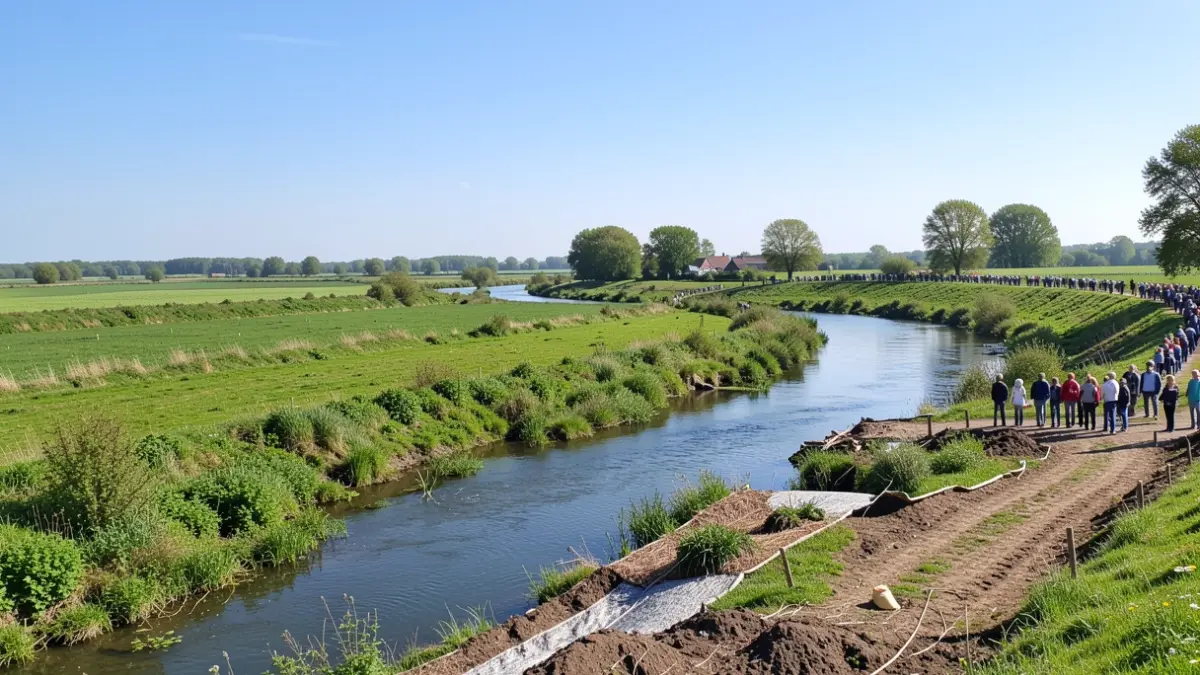
Within the Flemish project Reshape-D, measures will be implemented in the Dendervallei over the next six years, concluding on June 30, 2032. The objective is to improve water retention, restore wet nature, and make the valley more resilient to extreme weather conditions. The project officially commenced on July 1, 2026, and is co-financed by the European Union's LIFE programme with 8.45 million euros out of a total budget of 25.8 million euros.
The Dender river flows through a distinctly hilly landscape, which can cause flooding during heavy rainfall and water shortages during dry periods. Reshape-D aims to mitigate these extremes by enabling soils to function as natural sponges again. The project builds upon previous plans such as the Strategic Plan Space for Water Dendervallei and the action programme Green-Blue Dender Flanks.
The implementation is carried out by the Department of Environment, the Agency for Nature and Forest, De Vlaamse Waterweg nv, the province of East Flanders, Workroom vzw, and the Flemish Environment Company (VMM), which also manages coordination. A broad group of associated partners from Flanders, Wallonia, and the Netherlands are also involved.
A significant ambition is the creation of approximately 800 hectares of wet nature and floodplains. Potential interventions include restoring natural valley floors by removing hard surfaces and excavating, limiting the draining effect of ditches, and reconnecting interrupted water and nature corridors. These actions are intended to increase the valley's resilience to both floods and droughts, while also creating additional habitats for plants and animals.
Two pilot areas for large-scale valley restoration are the valley of the Molenbeek and Rijt between Zandbergen (Geraardsbergen) and Appelterre (Ninove), and the Bellebeek valley on the border of Liedekerke and Affligem. In Zandbergen, the Molenbeek will be connected to the Rijt, extending it by five kilometers and improving water availability. In the Bellebeek valley, a new culvert will be built, and treated wastewater will be used to supply a marsh area year-round, while the stream will regain some of its meanders.
The experiences gained from these areas are expected to provide valuable knowledge for other parts of the Dendervallei and similar valley regions in Flanders and Europe. The project emphasizes an integrated approach, fostering collaboration between Flemish authorities, local governments, farmers, nature organizations, businesses, and residents through information sessions, workshops, and participation processes.