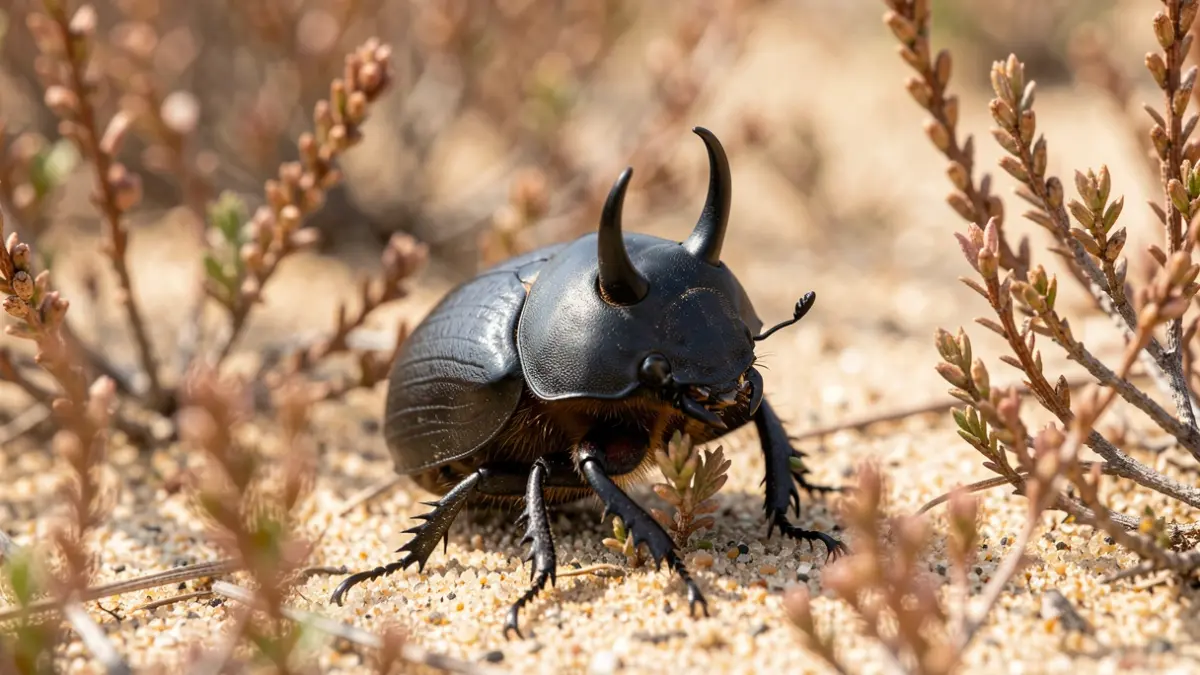
In October, a special heathland species is highlighted: the three-horned dung beetle. This insect can be seen this month at the Kesselse Heide.
The three-horned dung beetle is a beetle from the family of dung beetles (Geotrupidae). The beetle's black body can grow to be 12 to 20 millimeters long and is round and bulbous. The texture of the pronotum is smooth, while the elytra are deeply grooved lengthwise, and the underside of the insect is finely haired. You can easily recognize the three-horned dung beetle by its three prominent ‘horns’, two on the sides of the pronotum and a smaller one in the middle. Larger males have relatively longer teeth than females, where only traces of teeth are visible.
On the Kesselse Heide, the three-horned dung beetle is found in open, sandy areas. The beetle is winter-active and can be found between September and March. It feeds on the droppings of herbivores.
Dung beetles can be divided into three groups based on their reproductive method: dwellers (spend the entire reproductive cycle in a dung heap), tunnelers (dig tunnels), and rollers (roll portions of dung backward into balls, not found in Belgium or the Netherlands). The three-horned dung beetle belongs to the tunnelers, where both males and females dig a single vertical tunnel together, sometimes up to meters deep. They then create side tunnels that are packed with dung, with an open space at the end for an egg. All tunnels are sealed with earth. Once the nest is complete, the adult dung beetles die.
Dung beetles transport relatively large amounts of highly nutritious substances deep into the ground. It is calculated that the soil displacement by certain species amounts to hundreds of kilograms per hectare per year. Because many dung beetles live in sandy or heathland areas, they are important fertilizers of nutrient-poor soils.
Have you seen the three-horned dung beetle at the Kesselse Heide and managed to take a nice photo? Share your photo with us via facebook.com/kesselseheide or via waarnemingen.be.