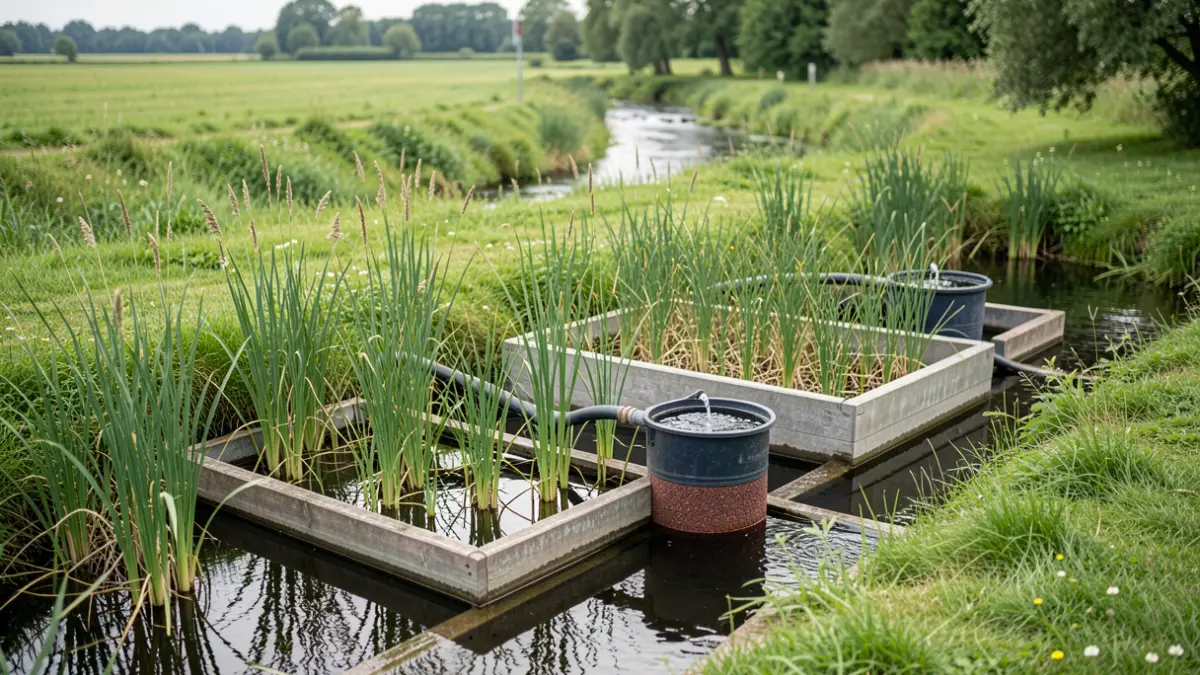
The new installation on the Ringbeek in Oostkamp, inaugurated on Friday, September 25, is designed to purify polluted stream water naturally. This project, a collaboration between the municipality of Oostkamp, Ghent University, and VITO, with support from the Interreg Flanders-Netherlands project Aquatuur, aims to protect the water quality of the Hertsbergebeek.
The system comprises a 8,500 m² helophyte filter, where plants and microorganisms purify the water, and a 400 m² iron sand filter that removes phosphorus. This combination helps absorb pollution peaks and ensures an almost energy-neutral purification.
Initial measurements are promising: the plant has demonstrated its ability to temporarily retain and purify polluted water during peak pollution events, significantly reducing nitrogen and phosphorus concentrations, including an over 80% decrease in phosphorus.
This pilot project, equipped with sensors for continuous water quality monitoring, provides valuable data for further research at Ghent University. The goal is to develop nature-based water purification techniques for broader application.
In addition to water quality, the installation enhances the area's biodiversity, water storage, and climate resilience. Fish ladders have also been constructed in the Ringbeek to ensure free fish movement.