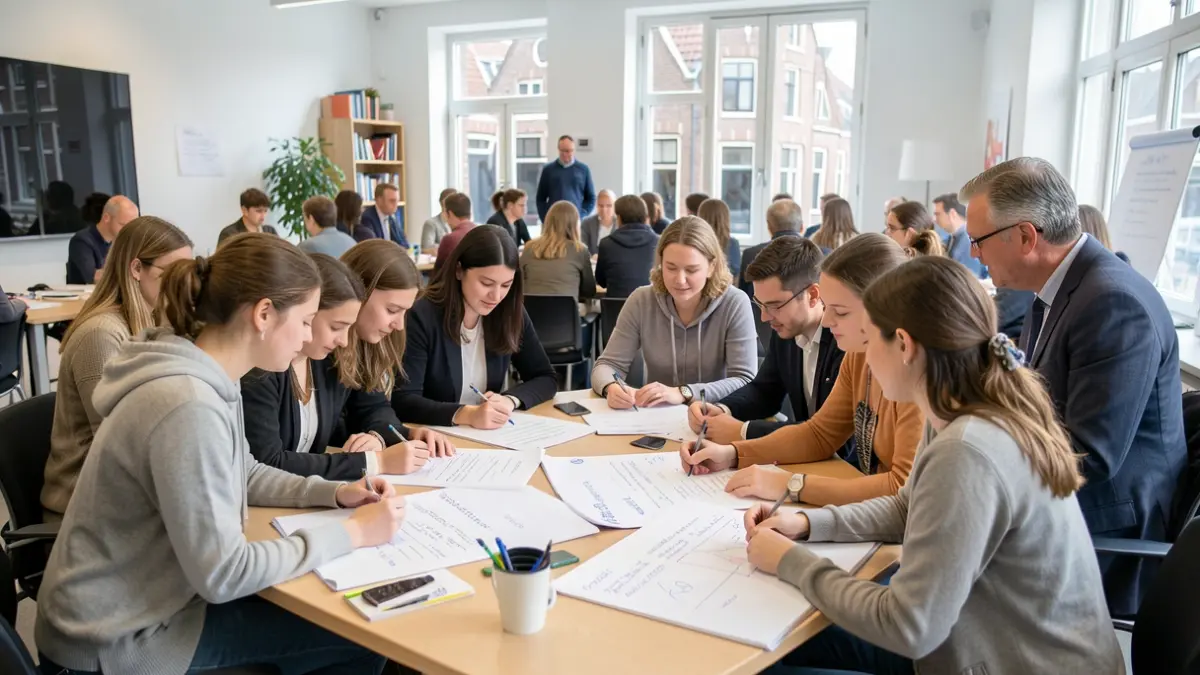
The international project, officially launched on October 15th at the UCLL campus in Diepenbeek, aims to develop new ways to give young people a voice and enable them to actively shape policy. The consortium has secured a European subsidy of €4.3 million, with over €1.25 million allocated to UCLL and the City of Hasselt.
The project focuses on young people aged 15 to 29, giving them an active role in developing, testing, and improving policy through innovative Policy Labs. Here, youth will collaborate with policymakers, youth workers, and educational professionals on current societal themes such as climate and the living environment. "Too often, young people are consulted after decisions have already been made," says Ann Reulens, project coordinator at UCLL. "Within CITADEL, we start from a different premise: young people are not just citizens of tomorrow, but also of today. We want them to help build solutions and policy."
Hasselt will serve as one of the European testbeds for developing and trying out new participation methodologies, with a special focus on youth who currently find it harder to engage in participation and consultation processes. Dries Martens, alderman in Hasselt responsible for youth and citizen participation, highlights the importance of innovation and experimentation: “In Hasselt, we already make many efforts to involve children and young people. At the same time, I see challenges in keeping them engaged and motivated. We saw that young people voted much less in the last elections, even though they will naturally live in our city the longest. Therefore, we want to continue innovating and experimenting in Hasselt. With this initiative, we hope to inspire not only our own youth but also other cities and educational institutions. This way, we collectively build a strong democracy where every young person feels heard and involved.” The first Policy Lab cycles will begin next September.
CITADEL, a three-year Horizon Europe project involving twelve partners from five European countries (Belgium, Cyprus, Romania, Latvia, Hungary, and Germany), aims to develop a model applicable elsewhere in Europe. The project operates in formal, non-formal, and informal contexts, and includes the development of new training modules for teachers and an online knowledge tool on citizenship and participation.
“"This is a unique opportunity to lay the foundations for a stronger democratic culture together with young people. Democracy is hard work and requires more than casting a vote every few years. It demands dialogue, collaboration, and engagement. With CITADEL, we want young people to experience how they can shape tomorrow's society today."
The project runs from 2026 to 2029 and initially focuses on local policy challenges, with the ultimate ambition of impacting at the European level.