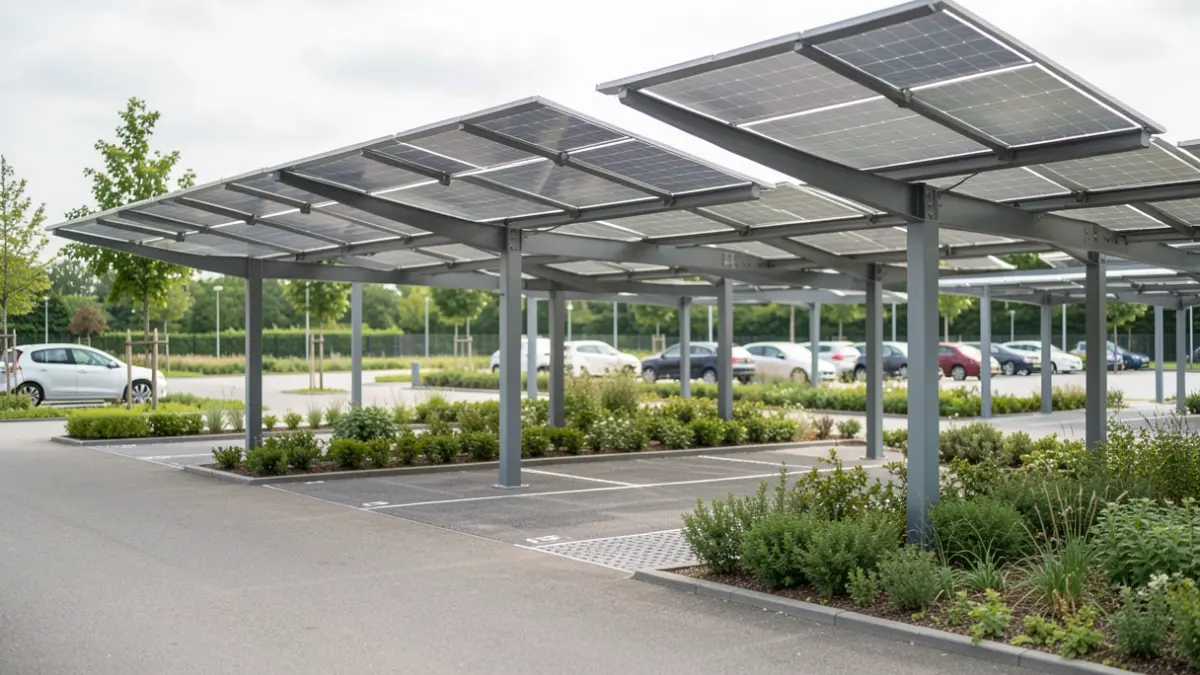
The Province of Antwerp sees solar energy as a crucial non-fossil energy source and is seeking alternatives to solar fields in open spaces. Parking lots are identified as suitable locations for solar panels, offering benefits such as avoiding additional paving, keeping parked cars cooler, and producing electricity locally.
The local use of solar energy is optimized by integrating charging stations into the parking lots. This minimizes the need for cabling and improves the management of energy generation, storage, and consumption. Furthermore, the lots can be redesigned with more greenery, permeable surfaces, and attention to water infiltration, benefiting the neighborhood.
Deputy Luk Lemmens explains that a concrete design is being prepared for two parking lots in Stabroek. Designers are tasked with making the solar parking lots as green and climate-resilient as possible, focusing on planting, heat protection, water infiltration, and rainwater reuse. The aim is to transform 'hard' infrastructure into a versatile asset for the neighborhood.
The parking lot of the Provincial Institute for Technical Education (PITO) and the parking area of the Picoloplein in Stabroek are the first sites for this research. The project could also resolve the electricity shortage at Picoloplein, making events possible. Liesbeth Bardyn, alderman for Spatial Planning, emphasizes that climate gains and a vibrant neighborhood go hand in hand.
Daniëlle Segers, general director of PITO Stabroek, expresses enthusiasm for the collaboration that connects sustainability, innovation, and technical education. Luk Lemmens adds that the results will be interesting for anyone wishing to transform parking lots into energy sources and support climate adaptation. The province hopes the designs can be realized after the research. The design research is expected to be completed by the end of 2026.