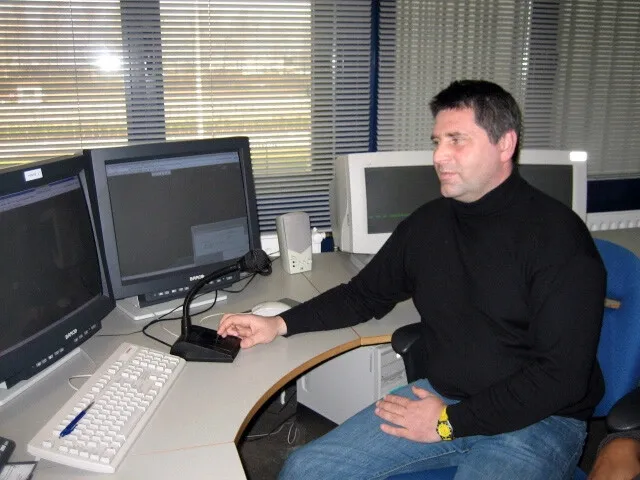
Philippe Delcroix, who progressed from traffic controller to regional traffic controller and now chief instructor, describes the early days as much more primitive. At that time, there were separate centers with their own directors, less integration, and many manual processes. The establishment of the Scheldt Radar Chain brought these links much closer together, functioning as a network.
The collaborative project, initiated in 1991 with Dutch government participation, is now an indispensable tool for guiding shipping. With six manned traffic control centers, over sixty radar posts, and recent expansions along the Ghent-Terneuzen Canal and a full traffic control center in Zelzate, the SRK continues to develop.
The technological evolution over the past 35 years is impressive. Radar screens have transformed from simple moving dots to integrated systems displaying ship identity, destination, and planned route. This allows traffic controllers to assess developing traffic situations much faster, a concept that seemed futuristic 35 years ago.
Operational reach has also significantly increased. Thanks to improved radar and detection technology, traffic control centers can now track ships much earlier, giving controllers more time to detect potential risks and react appropriately. Not only has the technology changed, but the training of traffic controllers has also become more professional, evolving from learning by listening to experienced colleagues to a comprehensive nine-month training program with modern simulators.
Today, aspiring traffic controllers do not need prior maritime experience; competencies and the willingness to undergo intensive training are key. The international standardization of procedures and the use of standardized maritime communication in English further enhance safety.
Throughout its history, the Scheldt Radar Chain has been shaped by significant incidents and accidents at sea. Events like the collision between the British Trent and the Western Winner in the early nineties highlighted the importance of reliable detection, communication, and traffic guidance. International incidents, such as the Tricolor disaster in 2001, also influenced the development of traffic management.
The expertise and experience gained within the Scheldt Radar Chain have also been exported abroad. In 2005, Flemish specialists assisted in developing a traffic management system in Thailand, training local personnel using simulators and paper charts.
Philippe Delcroix, who will soon hand over the reins, remains curious about the future, anticipating further technological changes that will continue to make the job attractive.