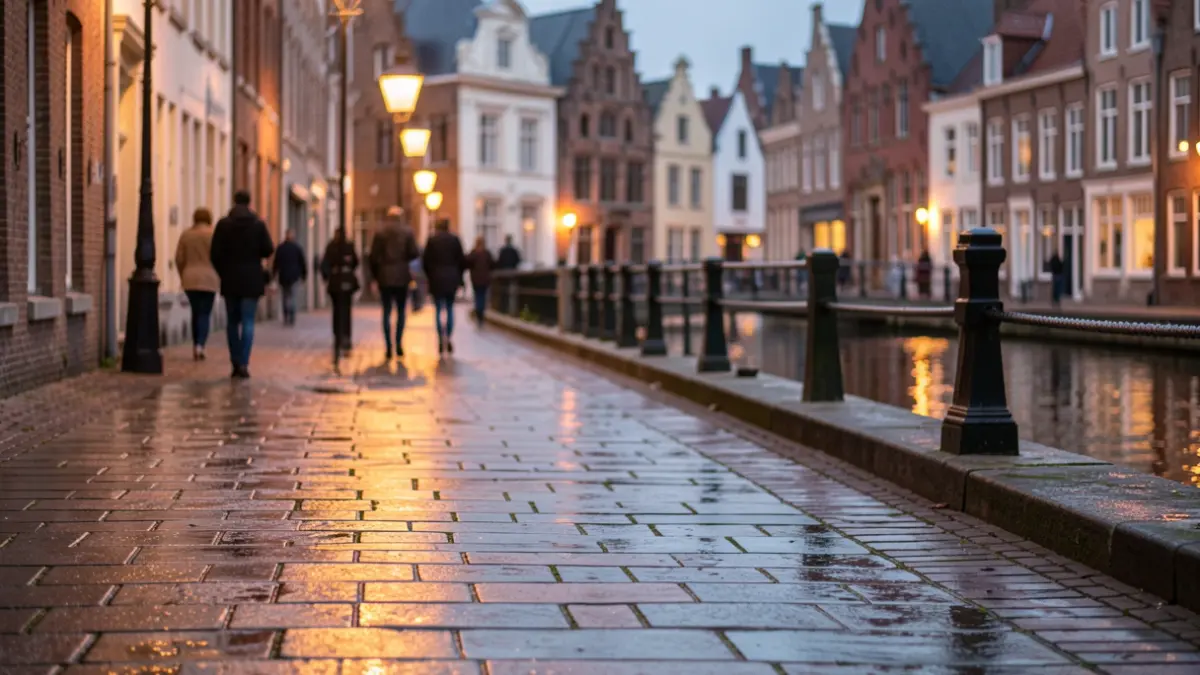
The first route uses the existing crossing at Oostmeers. Additional lighting will be installed at this crossing to improve the visibility and safety of pedestrians. The second route is new and opens on Friday, 27 November. Pedestrians and cyclists with their bicycles can cross the R30 temporarily at the height of Ketsbruggestraat and Hendrik Brugmansstraat. This crossing connects to two new embankment bridges, which will be accessible to pedestrians for the first time from then on.
The third route runs via the Unescopassage and the passantenbrug to the station entrance on the Sint-Michiels side. This connection runs completely outside the construction zone and has no traffic lights, making it often the fastest route for those walking from Koning Albert I-park to the station. The temporary crossing at Ketsbruggestraat and Hendrik Brugmansstraat is not step-free. People requiring an accessible crossing can continue to cross the R30 at Oostmeers.
To guide visitors to the various routes, the City of Bruges and the AWV are placing additional signage. Banners, information pillars and road signs make the alternative connections clearly visible. The two new embankment bridges have been named Pickerybrug and Keizerinnebrug. For the realisation, the City of Bruges and the AWV worked together with De Vlaamse Waterweg and the Heritage Agency. The bridges were carefully integrated into the historic embankment landscape.
The additional crossing has no impact on the flow of car traffic on the R30. The traffic lights are regulated so that pedestrians at the new crossing get green at the same time as pedestrians and cyclists crossing the Chantrellstraat. At that time, car traffic on the R30 and in the Chantrellstraat is already stationary for the red light. There is therefore no need for an extra green phase. The temporary crossing and the new embankment bridges will remain available throughout the entire year-end period.
From mid-January 2027, work will resume to further complete the connections. The crossing over the R30 will then be temporarily closed again.