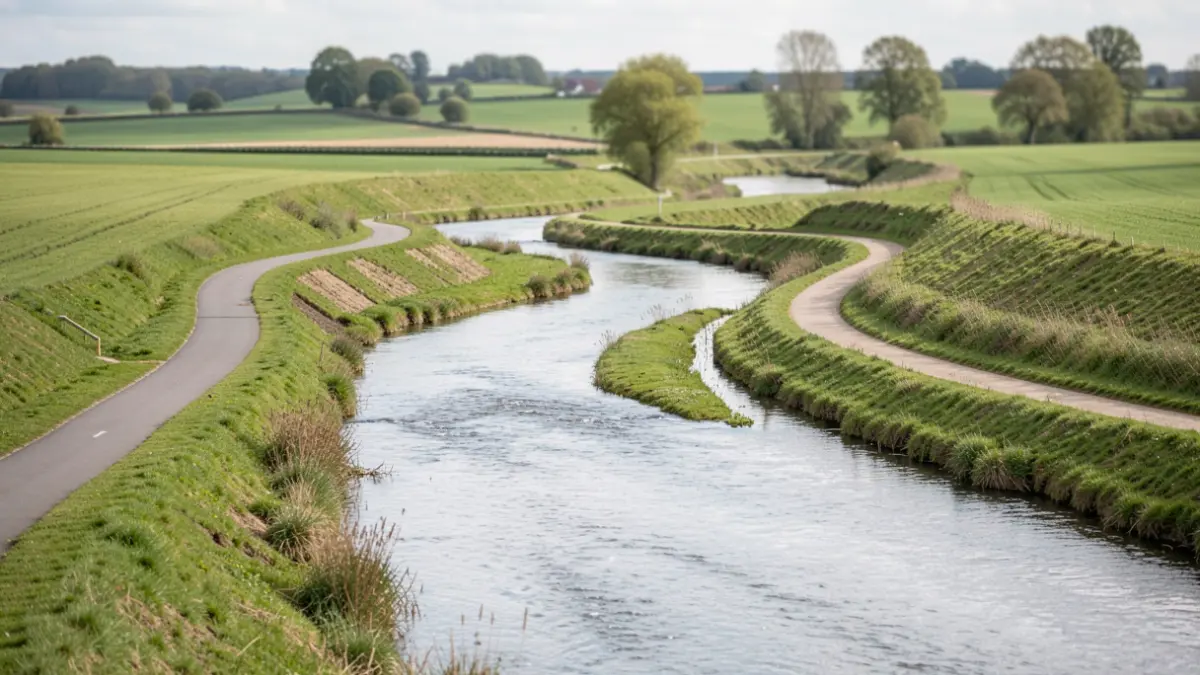
After two years of work, De Vlaamse Waterweg nv has reached a significant milestone in the Demer Valley. The nine historic meanders between Betekom and Werchter have been successfully reconnected to the Demer. The river now meanders again, better equipping the valley against both waterlogging and drought.
The old river bends were reconnected to the Demer one by one this spring. To allow water to flow through the meanders again, the existing riverbed was made narrower and less deep in several places, and where possible, the dikes were lowered. This allows the Demer to buffer water in the surrounding valley during high water levels. Just before its mouth in the Dijle in Werchter, the Demer dike was lowered to ground level over a length of 100 meters. Water flowing into the valley via the meanders and lowered dikes can return to the river once the water level drops.
These interventions enhance water storage in the Demer Valley and simultaneously help retain water longer during dry periods. During heavy rainfall, the river gains more space and the valley can temporarily store water. During low water levels, thresholds in the river ensure that the water level drops less, which also supports the groundwater level in the surrounding valley. These works on the Demer also lay the foundation for nature restoration, contributing to more natural groundwater levels, a crucial condition for restoring typical river nature with wet forests, marshes, and wet grasslands.
The restoration of the meanders also improves the living environment for fish, aquatic plants, and other species, including the bitterling, great crested newt, great crested newt, beaver, and black stork. The river bends provide more variation and oxygen in the water and strengthen riverine nature.
The works also include adapted recreational facilities. On the left bank, the old service road on the dike made way for the restored meanders. A new walking and cycling route follows the course of the former towpath and runs between Betekom and Werchter along the Demer and through the valley forest. Just downstream of the Betekom bridge, a new disembarkation point for paddlers has also been constructed.
“"With these nine restored meanders, we are giving the Demer the space to flow through the valley as a natural river again. This makes the environment more resilient to waterlogging and drought, strengthens riverine nature, and simultaneously enhances the experiential value of the Demer Valley. This project shows how water safety, nature restoration, and recreation can reinforce each other."
With the connection of the nine meanders, an important phase of the Sigmaplanproject Demervallei has been completed. Within this project, De Vlaamse Waterweg nv aims to eventually reconnect about thirty historic meanders to the Demer between Diest and Werchter.