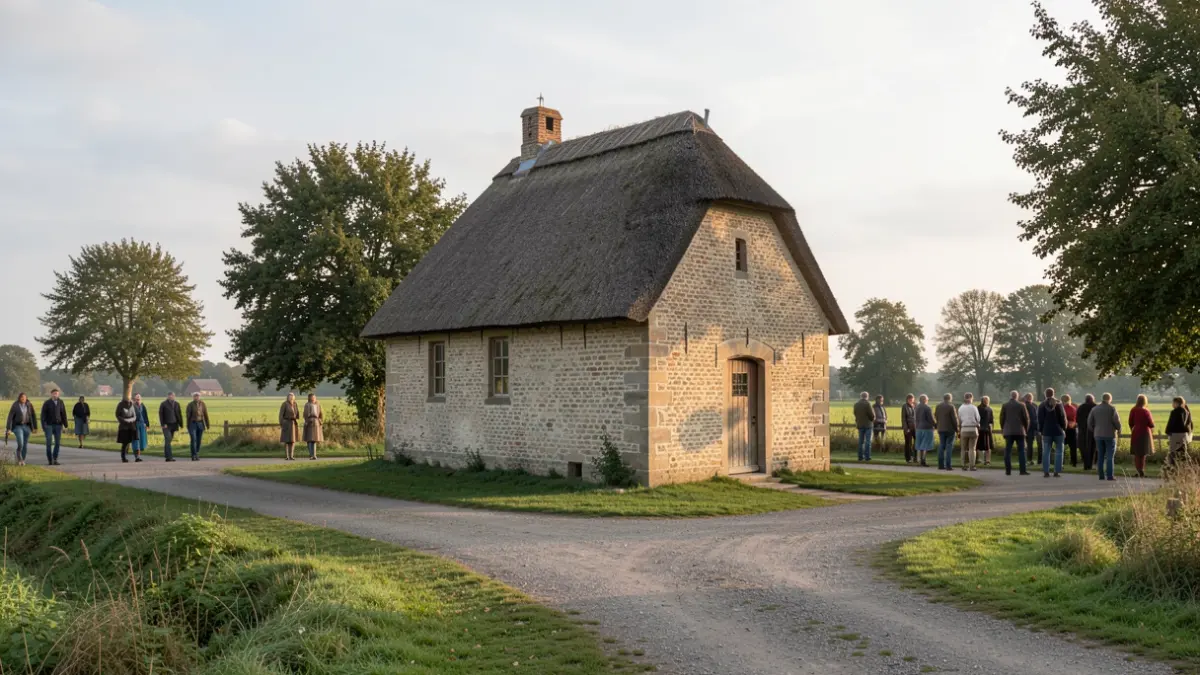
In the 15th and 16th centuries, Flanders, including Denderleeuw, was ravaged by several plague epidemics. Sick inhabitants were isolated in plague or leper houses to prevent further contagion. In Denderleeuw, such a primitive hospital was located at the crossroads between Aalst, Ninove, and Liedekerke: the current site of the Strokapel.
By the 16th century, the plague house fell into disuse, but the chapel remained. Around 1672, it was known as ‘het Capelleken te drij linden’. The name ‘Stroeyenkapelleken’ only first appeared in 1849.
Around 1939, the Strokapelleken was in a deplorable state. Under the impetus of assistant priest Maurits Van Geyst, a committee was formed in 1953 for its reconstruction. On May 31, 1953, the new Strokapelleken was festively consecrated.
In 2011, the Agency for Roads and Traffic (Agentschap Wegen en Verkeer) decided to redesign the crossroads for traffic safety. The chapel and adjacent houses were demolished. A crossroads without the Strokapelleken would not be the same, so the church board reached an agreement with the Flemish government for its preservation.
The local administration and the church council consulted, resulting in the new, current design, naturally with a thatched roof. The inauguration of the new Strokapel took place on May 7, 2017.
The information is based on the brochure ‘Strokapelleken’, compiled for the official inauguration of the new Strokapel on May 7, 2017.