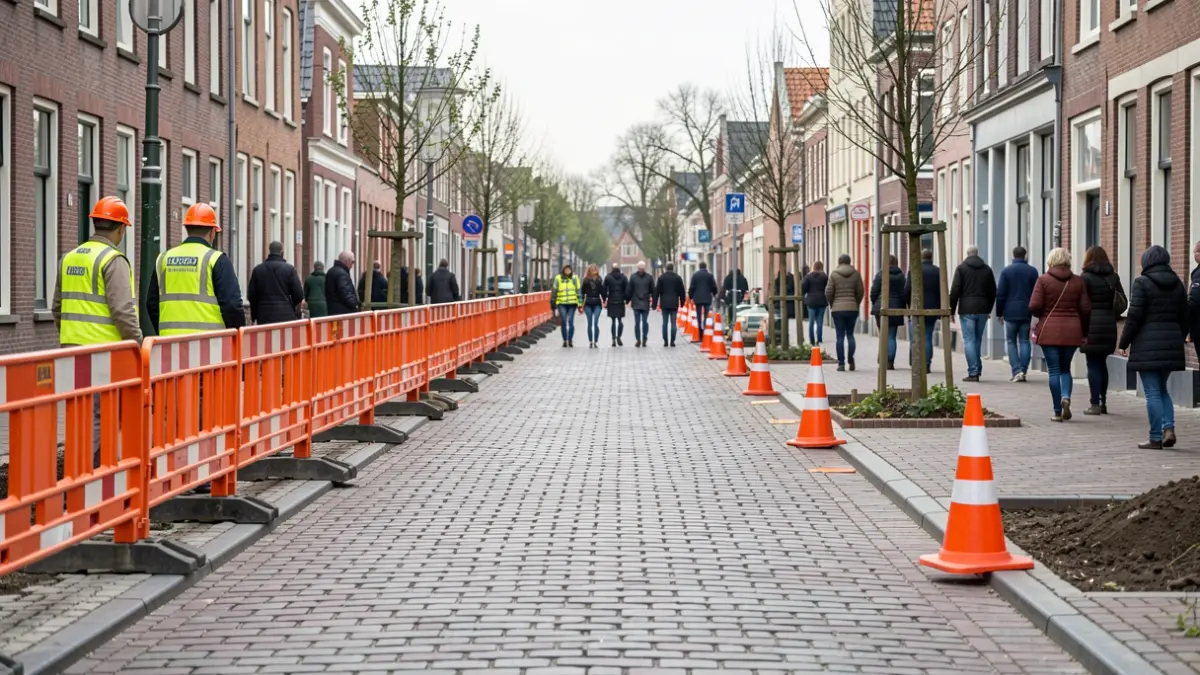
The planned works on Gentsestraat and Vlaanderenstraat in Aalst aim to enhance accessibility for all road users. This includes the installation of level crossings, tactile paving at pedestrian crossings, wider sidewalks of at least 1.50 meters, and minimal gradients for wheelchair users. The roadway will also be widened to accommodate more pedestrian space.
The renovation will structure the street using different materials to improve liveability. Clearly marked parking spaces are intended to improve traffic flow, increase safety, and make waste collection more efficient. This will also contribute to faster emergency service response times.
The street will be transformed into a boulevard featuring Roman porphyry and trees, creating a visual connection to the Vredeplein and Nieuwstraat. This is expected to boost local commerce and hospitality, and increase property values. The 26 new trees and undergrowth will purify the air, provide shade on warm days, and absorb CO2, enhancing long-term liveability.
The design, incorporating grass pavers and tree pits, allows rainwater to seep into the ground, replenishing groundwater levels and helping to prevent flooding. This is particularly important given the low groundwater availability in Belgium.
The project will commence with preliminary design and public consultation, followed by preparatory utility works starting on October 20, 2025. The actual reconstruction is scheduled in four phases from February 23, 2026, to January 22, 2027, with potential adjustments due to site and weather conditions.
Phase 1 runs from February 23 to early May 2026 in the Gentsestraat and a section of Vlaanderenstraat. Phase 2 (March 23 to mid-June 2026) focuses on Vlaanderenstraat and a part of Gentsestraat. Phase 3 (June 22 to end September 2026) includes Klein Parksken and the Gentsestraat. Phase 4 (mid-September to early December 2026) will work on another section of the Gentsestraat.
Traffic measures will be in place during the works. Pedestrians and cyclists with destinations within the construction zone can pass (with bikes in hand); others will need to detour. De Lijn is adjusting its schedules. Motorized traffic will face interruptions and diversions, particularly in the Gentsestraat, Klein Parksken, and the intersection with Nieuwbeekstraat. From early October 2026, parts of the Gentsestraat and Klein Parksken will reopen for local traffic.