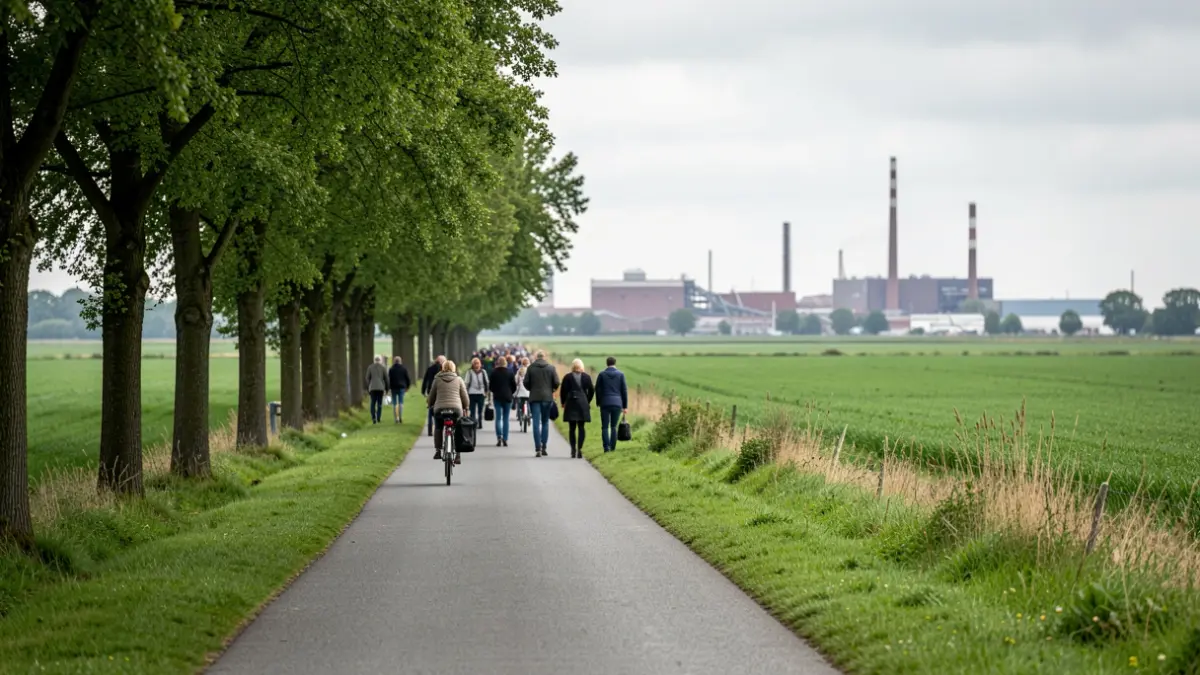
The final design for the FR02 cycle link, a key part of the Routeplan 2030 cycle network, has been approved. The planned cycle route is 5.5 kilometers long and runs from the district of Merksem through the municipalities of Schoten and Wijnegem to Deurne. This project, part of the ‘De Nieuwe Rand’ initiative, addresses a crucial missing link between Merksem and Wijnegem and connects to various existing cycle routes. This will create a fast, comfortable, and clear cycle network linking the districts and municipalities in the green eastern fringe of the city of Antwerp. The final design will be submitted for approval to the districts of Deurne and Merksem and the municipalities of Schoten and Wijnegem. If all proceeds smoothly, work can begin in 2028.
The new cycle link starts in Merksem, crosses the Albert Canal, and ends in Deurne. The route also passes through the reserve strip of the A102 motorway.
“"With this cycle link, another missing piece is being addressed, between Merksem and Wijnegem. Cyclists will soon be able to cycle smoothly from Merksem to Deurne, with safe crossings at regional roads. In this way, together with our neighboring municipalities, we are further developing the cycle network from our transport region's Routeplan 2030."
Beyond infrastructure, the project also focuses on improving nature, water, heritage, landscape, and spatial quality, ensuring the new cycle paths are well integrated into their surroundings. There will be several fully accessible rest stops at interesting locations along the route. Cyclists can, for example, rest and learn more about historical sites at the fort of Merksem or at the ‘Dnjepr’, an anti-tank ditch from World War II on the border of Merksem and Schoten. Archaeological research conducted before the start of the works will also provide information on any interesting findings.
The cycle link passes not only through a green zone but also contributes to increased greenery. Where space permits, a row of trees will be planted along the cycle path. Near the ZAS Palfijn in Merksem, a new section of forest will also be planted. Additionally, hedges will be added, forming a green buffer of about five meters wide between the cycle path and, for example, an industrial area.
Several swales will also be constructed for better water infiltration into the ground. The planting of various plant species on the slopes of these swales will attract diverse fauna and flora. Where possible, existing roads will be de-paved, such as the Muggelei in Wijnegem. This section will feature cobblestones in the middle with joints that allow rainwater to seep into the ground, with paved strips on either side for safe and comfortable cycling.
Finally, safe cycle crossings will be provided at intersections with regional roads, such as near the former Makro site or the Bredabaan.
The final design will be submitted for approval to the districts of Deurne and Merksem, and the municipalities of Schoten and Wijnegem. Subsequently, a collaboration with all partners will be established to develop it into a technical implementation dossier, which will form the basis for the environmental permit application. Realization is expected to start in 2028.
The project is a close collaboration between the city of Antwerp, the municipalities of Schoten and Wijnegem, and the districts of Deurne and Merksem, along with a broad group of partners within De Nieuwe Rand, including Flanders and the Province of Antwerp, led by Cathy Berx, governor of Antwerp. It presents an opportunity to make this route fully cyclable in the short term with limited resources.