Flanders welcomes first 7 Tesla MRI scanner for advanced medical research
New scanner with exceptional field strength opens doors for research into various diseases and development of new imaging techniques.
By Wouter De Smet
••3 min read
AI
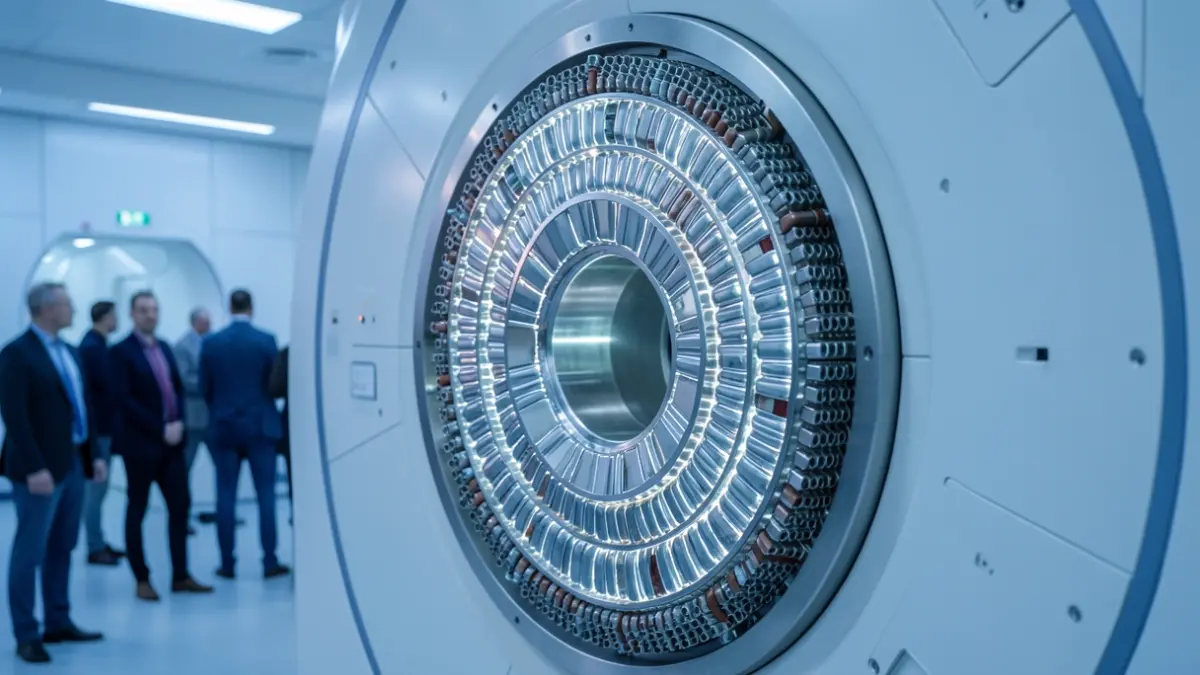
Generic image: focusing on the magnetic coil and the sterile, technological environment. No people or text.
The Vrije Universiteit Brussel (VUB) is coordinating the arrival of Flanders' first 7 Tesla MRI scanner, a project granting researchers from various disciplines and institutions access to advanced imaging technology.
The new scanner, operating with a magnetic field of 7 Tesla – more than twice as strong as conventional scanners – promises an exceptionally detailed view of the human body's anatomy, function, and metabolic processes. This stronger signal allows for sharper imaging of structures, better study of subtle tissue differences, and investigation of molecular processes like changes in sodium, phosphorus, or glucose concentrations.
The scanner will be used for research into conditions such as epilepsy, multiple sclerosis, dementia, tumors, kidney diseases, and cartilage degeneration. The development of new MRI techniques in neurology, oncology, and orthopedics is also planned.
The project, named Flanders 7T, is a unique collaboration between the five Flemish universities – VUB, KU Leuven, University of Antwerp, Ghent University, and UHasselt – and the four university hospitals: UZ Brussel, UZ Leuven, UZA, and UZ Gent. This pooling of expertise aims to enable research projects that transcend the boundaries of a single institution or discipline.
“
"With Flanders 7T, the Flemish universities and university hospitals demonstrate what becomes possible when we combine our knowledge, infrastructure, and expertise. This scanner is much more than a high-tech device: it creates a shared platform where researchers from different disciplines can jointly answer new scientific questions."
The scanner is primarily a research instrument. Scientists will systematically investigate the capabilities of ultra-high-field MRI in the coming years and develop new techniques. Its potential lies in better understanding disease processes by more accurately imaging small anatomical and functional abnormalities, which can contribute to earlier diagnostics and more targeted treatments.
“
"The added value of 7 Tesla is not just that we can see smaller structures more sharply. We can also gather information about processes in the body that are much harder to access with classical MRI. Think of changes in metabolism or the function of certain brain areas."
“
"We have succeeded in bringing together Flanders' most important MRI expertise in a single project around 7T MRI. It is therefore our intention to help facilitate the transition from scientific research to the clinic – together with GE HealthCare."
“
"This milestone demonstrates what becomes possible when researchers, clinicians, and technological innovators join forces around a common ambition. Our 7T MRI technology offers the Flanders 7T consortium a powerful platform to explore important research questions in neurosciences, musculoskeletal imaging, and advanced MR methods."
The investment, made possible by financial support from the Flemish government (€2.1 million) and the Research Foundation Flanders (FWO) (€2 million), strengthens Flanders' position in international ultra-high-field MRI research.
“
"Flanders may seem small, but our ambition is great: we are pioneers in many areas and invest heavily in innovation. I am also pleased that this investment has found its way to the Vlaamse Rand: the heart of the country, where hard work is also being done. We can certainly be prouder of what is happening here."
“
"What remains hidden in the human body today, researchers may soon be able to make visible with this scanner. That opens new perspectives for research into diseases like Alzheimer's, epilepsy, and cancer. This impressive project shows how much scientific power we have here in Flanders and Brussels."
Based on information from the official source: UZ Brussel — Nieuws (17/11/2026)